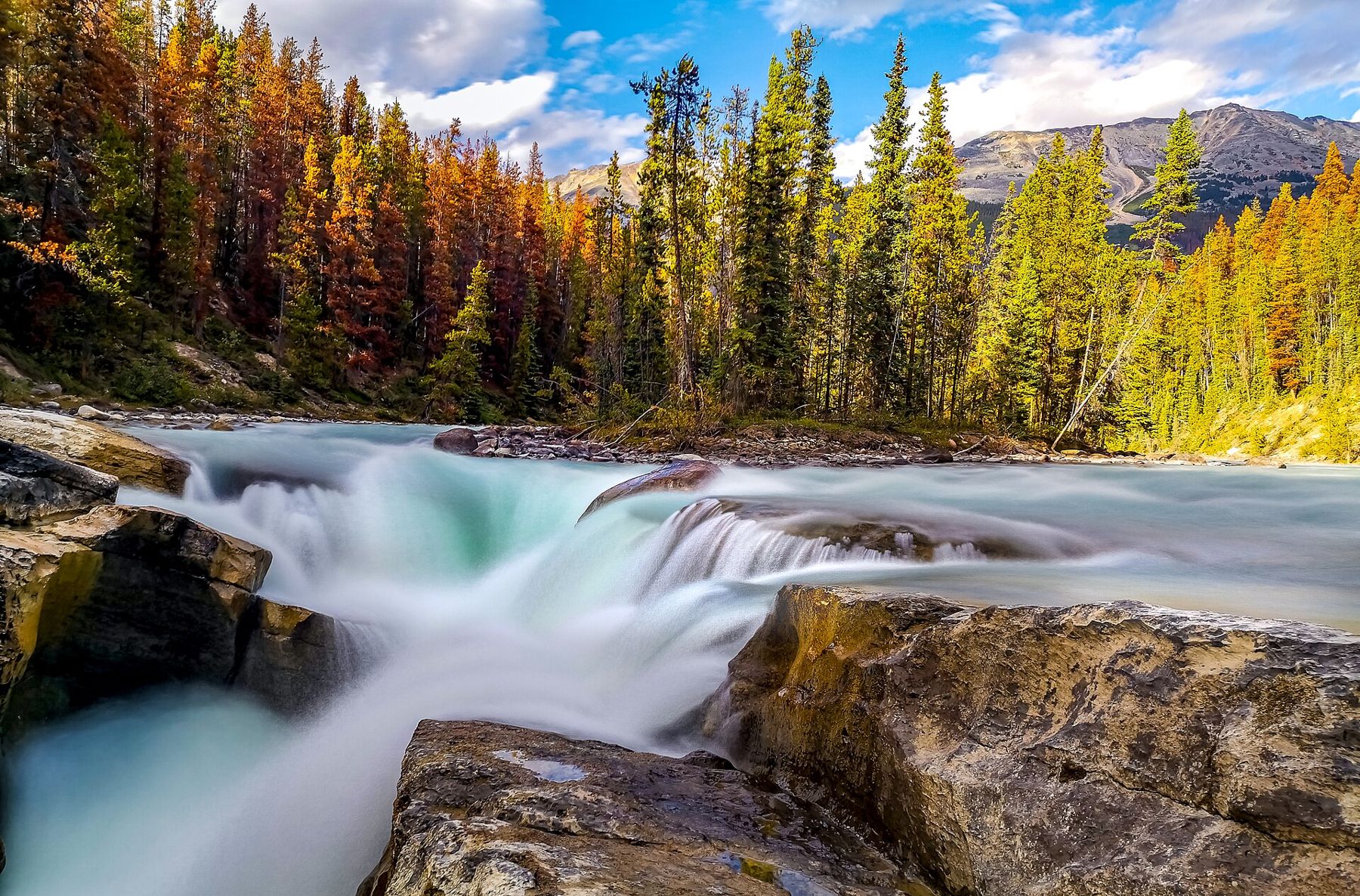
The northern end of the Icefields Parkway runs down the long valley of the Sunwapta and then the Athabasca River towards Jasper. After the drama of the Columbia Icefield, the road settles into forest and wide river flats, and many drivers are tired by this point. Two stops are worth saving energy for: Sunwapta Falls and Athabasca Falls, both a few minutes off the highway and both among the most powerful waterfalls in the Rockies.
They are different in character. Sunwapta drops around an island into a deep, narrow canyon; Athabasca is a broad river forced through a gap in hard rock. Seeing both takes about an hour, and they break up the last stretch of the drive nicely.
Sunwapta Falls
Sunwapta Falls lies about 55 km south of Jasper, at the end of a short side road with a car park. The Sunwapta River, milky with glacial silt, divides around a small wooded island just above the falls and then plunges into a narrow limestone canyon. A footbridge crosses the gorge directly above the drop, and from it you look straight down into the churning water.
The name Sunwapta comes from a Stoney word meaning turbulent water, and it fits. The canyon walls are steep and close, and the noise is impressive, especially in early summer when snowmelt swells the river.
Most visitors see the upper falls from the bridge and the viewpoints near the car park, which takes about fifteen minutes. A trail continues downstream through forest to the lower falls, a series of smaller cascades in a deeper canyon, about 1.3 km each way. It is quieter and worth the walk if you have the time.
Athabasca Falls
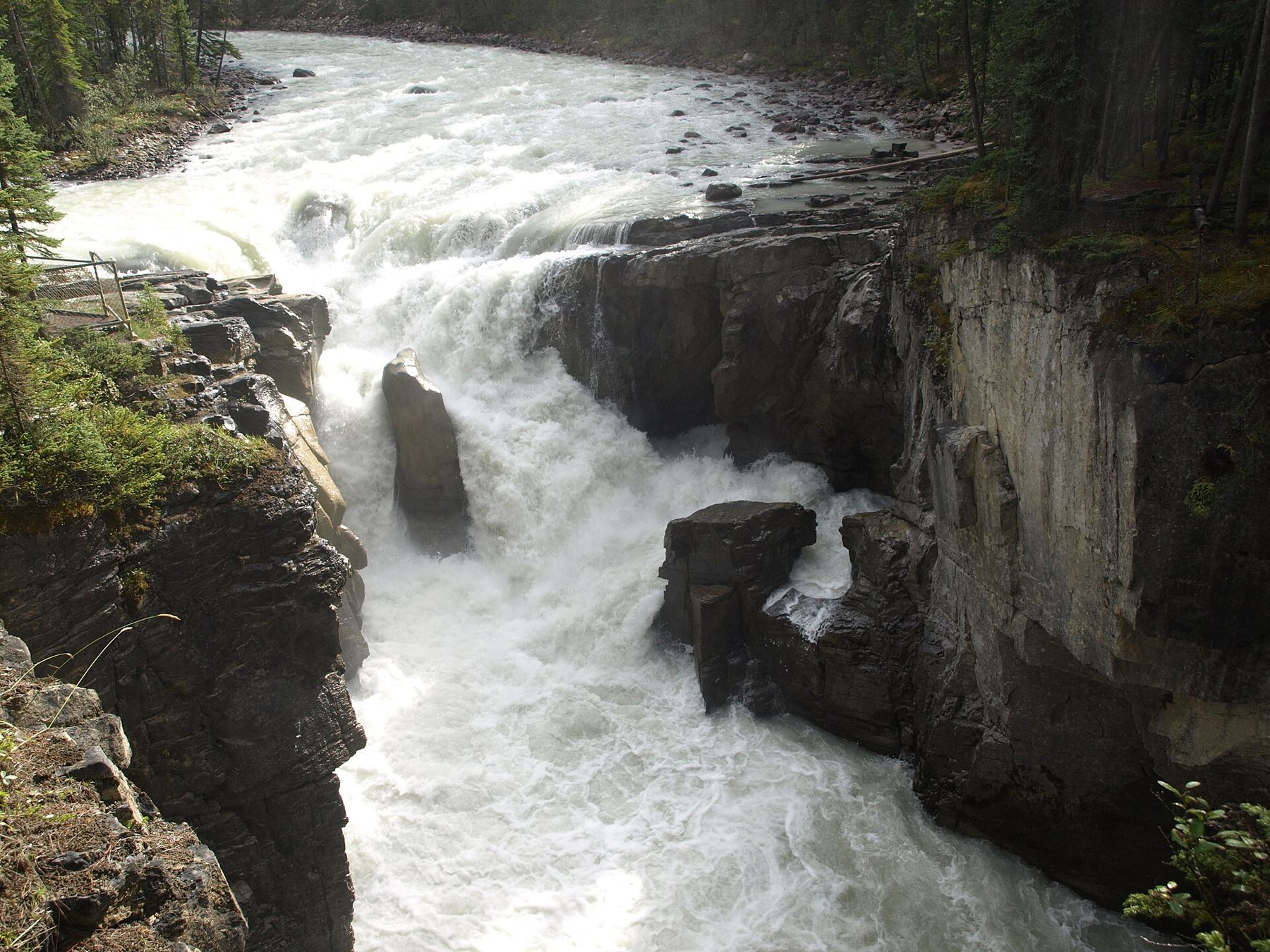
About 30 km south of Jasper, close to the junction with Highway 93A, Athabasca Falls is the more famous of the two. Here the Athabasca River, already a large river fed by glaciers upstream, pours over a ledge of hard quartzite and squeezes into a narrow gorge. The falls are not especially high, around 23 metres, but the volume of water is enormous, and the force of it is the point.
Paved paths and viewing platforms lead around the falls and across a bridge over the gorge. Below the main drop, the river has carved the rock into smooth channels and potholes, and part of the path leads down a stairway through an old, dry channel the river abandoned long ago. The walls are polished and curved, a sculpture made by water.
How potholes form
Also on Highway 93Walking to the toe of the Athabasca Glacier, and why the markers matterThe potholes in the rock at both falls are made by the river itself. Where the current swirls in an eddy, it spins pebbles and sand round and round in a small depression, grinding it deeper and wider over time. Some potholes are small cups; others are deep enough to stand in. At Athabasca you can see potholes at all stages, some still full of water and stones, others high and dry where the river once flowed.
The danger at the edge
Both falls are dangerous, and people have died at each of them after climbing over fences or onto the rocks for a better view or a photograph. The rock near the water is wet, polished and slippery, the current is powerful and very cold, and anyone who falls in is unlikely to survive. Stay on the paths and behind the railings at all times, and keep children close.
Signs at both sites make the point bluntly. Take them seriously, and do not follow anyone who ignores them.
Light, spray and the best hour
Both gorges are deep and shaded, so direct light reaches the water for only part of the day. At Athabasca, the late afternoon sun shines up the river from the west and lights the spray, and on a sunny day a rainbow often hangs over the main drop. Early morning is quieter, with mist rising from the gorge on cool days. Sunwapta is lit best around midday.
The volume of water changes through the season. In June and July, swollen with snowmelt and glacial meltwater, both falls are at their loudest and wildest, and the spray soaks the viewing platforms. By September, the flow drops and the water clears, showing more of the shapes in the rock.
In winter the falls partly freeze, with ice building up around the edges of the gorge while water still thunders through the middle. The paths are not maintained in winter and can be dangerously icy.
Highway 93A and the old road
At Athabasca Falls, Highway 93A branches off on the west side of the river. It is the old route of the parkway, narrower and slower than the main road, and it rejoins Highway 93 closer to Jasper. It passes the turn-off to the road to Mount Edith Cavell, a high peak with a glacier and a short trail to a meltwater lake, which is open seasonally and has its own access rules. Check before you plan to go.
The 93A is a good alternative for the last few kilometres into Jasper if you want a quieter drive.
Fitting them into the day
Most people see these two falls on the way north at the end of a long day on the Icefields Parkway. In late afternoon the light falls into the gorges and catches the spray. If you are staying in Jasper, they also make an easy half-day trip from town, perhaps combined with the Maligne Lake road on another day. Bring a rain jacket: the spray at Athabasca soaks anyone who stands near the edge of the platforms on a windy day.